
Furan grout is a water-free, chemical-resistant resin grout used mainly in industrial tile and brick installations. It handles conditions that can damage ordinary cement grout, including chemical exposure and high temperatures.
We consider chemical compatibility the main reason to select it, rather than appearance or routine household durability. Its composition and installation requirements explain where it belongs.
Key Takeaways
- Furan suits demanding industrial environments, but chemical resistance depends on the formulation and exposure.
- Black color, specialized installation, and difficult cleanup limit its appeal for homes.
What Makes Furan Grout Different?
Furan is one of three major grout classifications, alongside Portland cement-based and epoxy-based grouts. Its name comes from furfuryl alcohol, which is used to make the resin.
Resin, filler, and acid curing
The two-component system combines a furan resin binder made from furfuryl alcohol with filler powder. An acid catalyst triggers polymerization, which hardens the mixture into a thermosetting material.
Unlike cement grout, it contains no mixing water and doesn’t rely on cement hydration. That difference also changes its working and cleanup requirements.
Filler choices and color
Manufacturers offer carbon-filled and silica filler formulations for different service conditions. Carbon-filled furan supports strength and durability in demanding service.
Furan grout is generally manufactured only in black. Consequently, it offers little scope for matching decorative tile or creating contrasting joint colors.
Where Furan Grout Is Used
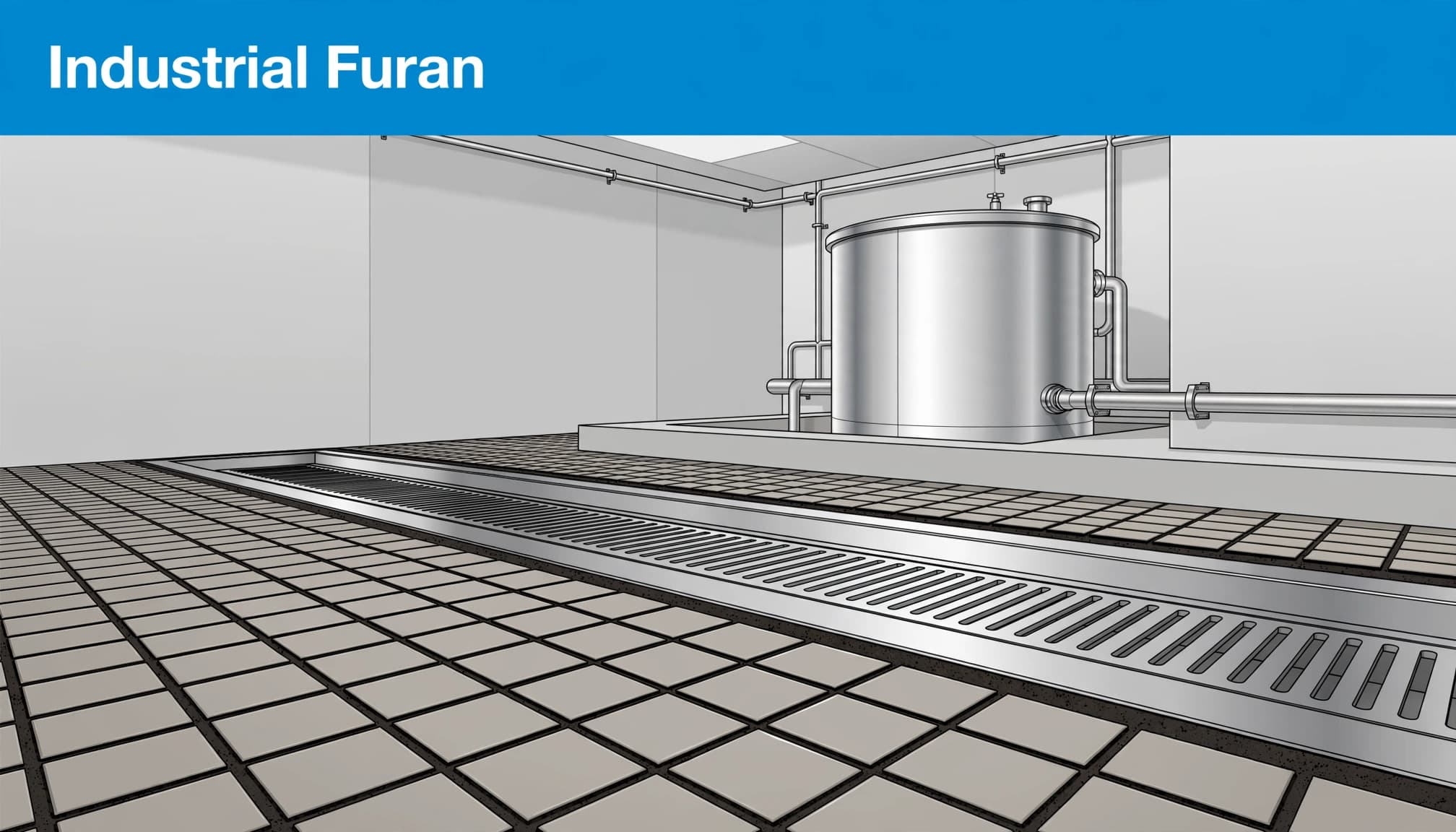
Typical applications include chemical-processing floors, sumps, trenches, tanks, and bleach towers at food and beverage plants. Breweries, canneries, dairies, laboratories, steel mills, and pulp and paper mills also use these systems.
For example, Sauereisen’s furan mortar and grout targets industrial chemical exposure, including applications in laboratories and mills.
Some formulations are low odor. USDA-authorized products also serve federally inspected meat and poultry plants. However, low odor doesn’t remove the need for ventilation, protective equipment, or controlled installation.
Chemical Resistance and Temperature Limits
Resistance depends on the chemical
Furan grout resists many acids, alkalis, oils, greases, and solvents. However, no grout resists every chemical under every condition.
Furan can react with substances that an epoxy formulation withstands, while the reverse also occurs. Compatibility testing must account for concentration, exposure temperature, and contact time. Treat these conditions as selection requirements rather than assuming either resin is universally superior.
Continuous service differs from peak exposure
The FURATHANE GROUT technical sheet lists continuous service up to 350°F (177°C) for that product. Ratings vary by formulation.
Peak limits can reach 450°F (232°C) for suitable formulations. A peak rating doesn’t authorize continuous operation at that temperature. These figures are product-dependent service limits, not universal temperatures at which every furan installation suddenly fails.
Furan Compared With Other Grouts
The main differences involve chemical exposure, installation, and maintenance.
| Grout type | Main advantage | Main limitation |
|---|---|---|
| Furan | Industrial chemical and heat resistance | Specialized installation; generally black |
| Epoxy | Strong stain, fat, and acid resistance | Higher cost and demanding cleanup |
| Modified epoxy | Hardness and stain resistance above ordinary cement grout | Cement-containing formulations need sealing |
| Portland cement | Practical for routine tile installations | Porosity and lower chemical resistance |
The correct choice depends on exposure, rather than a universal ranking of strength.
Epoxy uses epoxy resin as its binder and forms dense, essentially nonporous joints when installed correctly. Installation defects can still leave pinholes. Use epoxy-safe cleaners because unsuitable acid cleaners can cause cracking, chipping, or surface haze.
Cementitious grout includes options such as latex-modified grout, while modified epoxy grout combines epoxy with cement. Some cement-based formulations use a water-retentive additive to slow moisture loss during curing. Our guide to cement grout explains why identifying the binder matters before maintenance.
The 2005 ANSI references identify furan under ANSI A 118.5, epoxy under A118.3, modified epoxy under A118.8, and Portland cement grout under A118.6. These are material performance specifications, not installation instructions. The ALKOR MORTAR technical sheet also references A118.5 for chemical-resistant furan mortar.
Why Installation Requires Specialists
Furan grout is substantially more difficult to install than ordinary cement or epoxy grout. Traditional installation requires a protective wax coating on tile faces before grouting, followed by steam cleaning to remove residue.
Installers must control component proportions, working time, surface preparation, and curing. Chemical service requires a full cure, not just a dry-looking surface. We recommend qualified industrial installers for this work.
Conventional cement-grout rules for grout joints don’t automatically apply to furan. Traditional sanded grout generally suits joints 1/8 inch or larger, while non-sanded grout generally suits joints 1/8 inch or smaller. Follow product requirements and check surface compatibility.
Where sanded Portland cement grout requires damp curing, kraft paper is preferable to plastic. Plastic can trap condensation and contribute to uneven curing and discoloration.
Frequently Asked Questions
Is furan grout suitable for household tile?
Usually, its industrial properties don’t justify the installation difficulty or limited color choice. Cement or epoxy grout generally fits residential requirements better.
Can a stronger grout stop recurring cracks?
No grout corrects loose tile or an unstable subfloor. Movement needs repair before regrouting. Also, grout doesn’t replace the waterproofing system beneath a wet-area installation.
Choose Grout for the Actual Exposure
Furan grout belongs where documented chemical and heat resistance justify specialized installation. For ordinary floors, correct identification and compatible maintenance matter more than choosing an industrial material.
For tile and grout cleaning and sealing in your home or office, Get a FREE Quote. We can help protect sound grout without treating every stained floor as a replacement project.